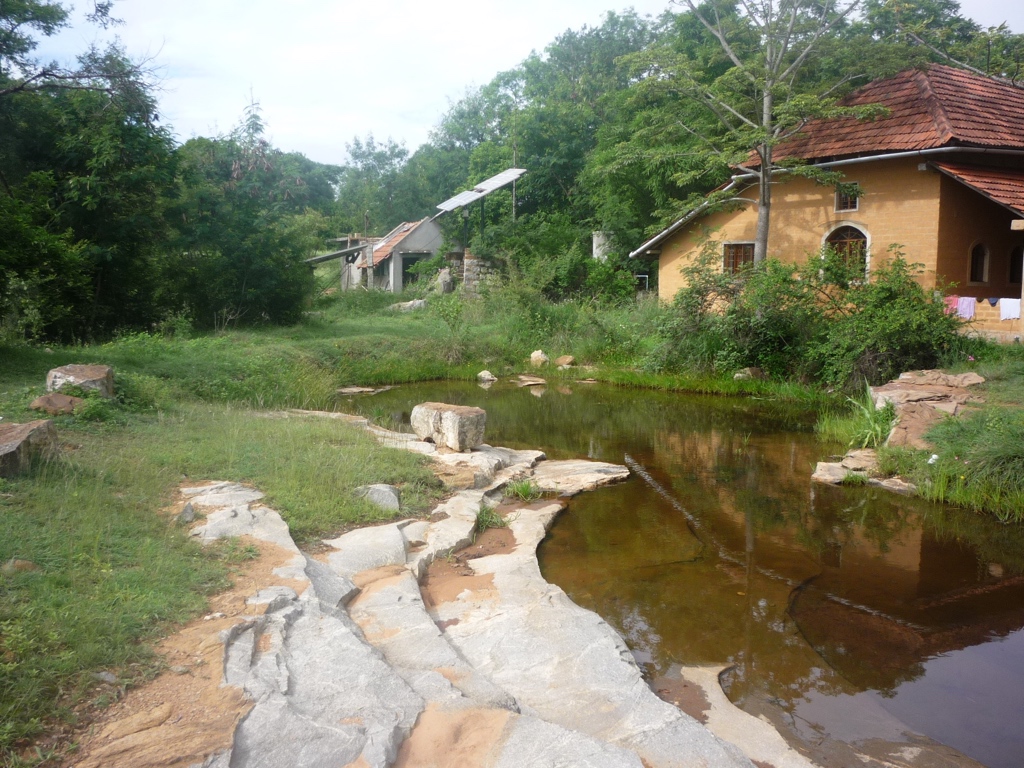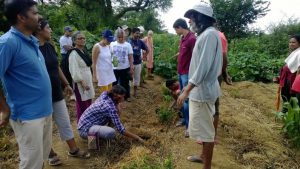
Navadarshanam ("New Vision") is a small organization, a registered charitable Trust operating near a small village 50 km south of Bangalore, India. It investigates ecological and spiritual alternatives to the modern way of living and thinking.

Navadarshanam is an exploration of alternatives to the modern way of living and thinking. Its origin can be traced to a Study Circle that used to meet in Gandhi Peace Foundation and the Indian Institute of Technology at Delhi in the 1970s and 1980s. A decade of study, introspection and discussion among these concerned individuals led them to the conviction that the urban-industrial way of life was leading to alienation of the individual from self, nature and the Creative Power, resulting in ecological destruction, increasing poverty, unemployment and unmanageable levels of social disintegration and violence. To get away from this vicious cycle, they felt the need to explore alternatives to the modern way of living and thinking. In particular, they felt the need to explore the possibility of a new kind of science and technology: a science that would recognize the realities of the spiritual dimensions, and concomitant technologies that would enhance rather than destroy ecology. Central to this way of thinking is the recognition that there exist forces which are invisible to our physical senses, but are nevertheless the centres of power in shaping our universe and in taking care of its ecological balance.

To give these ideas practical shape, in 1990-91 they created a Trust and bought 115 acres of land next to a small hamlet about 50 km from Bangalore. This land was completely degraded and unproductive at that time. On this land, they have conducted experiments in the following five areas:

1. Eco-restoration: Merely by preventing grazing, the land has been converted from wasteland to a nascent forest. Thousands of trees have appeared, planted by the mysterious forces of nature invisible to the senses. Soil conditions have improved dramatically.

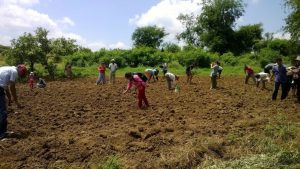
2. Natural farming: On this improved soil, in limited and carefully selected areas, fruit saplings and a few vegetables and cereals/pulses have been planted with minimum disturbance to those trees and bushes which have come up naturally. No chemicals and pesticides are used, the faith being that a healthy soil will take care of all plants in its bosom. This process is aided by lots of mulching around the plants.

3. Health and food: Based on the principles taught by a Swamiji of a nearby Ashram, food items and cooking methods have been classified according to digestibility/acidity-alkalinity. Diseases are seen as `absence of ease’, caused by undigested food, which disturb the ecology of the body. The subtler (‘pranic’) forces responsible for restoring this ecology are encouraged to play their role more effectively by changing our food patterns such that digestion is easy and effective. Food items developed along these principles have been made available to our network of friends in Bangalore.

4. Energy: Because of the ecologically damaging nature of the technologies that generate power these days, and also their centralized and user-unfriendly administration, connection from the state’s grid has been shunned. Instead, all power requirements, including that for pumping water and for lighting, is generated through solar panels and systems, wind power and also from oil made from the seeds of honge, one of the trees that nature has brought up in a big way during the regeneration process. Gobar gas (methane from cow dung), charcoal made on the land and wood stoves are used for cooking needs.

5. Housing: All dwelling units at Navadarshanam have been constructed with the help of alternative technologies, using eco-friendly concepts (such as compressed mud blocks). The philosophy adopted has been to combine ecology with economy. Thus, least amount of cement and steel has been used, instead the stress is on locally available material and labour. The house designs maximize the use of nature’s bounties – the breeze is such that no fans are needed even in the summer months, and no artificial lighting is required during day hours.

While the above five give an idea of the kind of work done by the Nd team, this represents only their work in the world ‘out there’. Their main stress has been on ‘inner work’ – purification of the mind. They wish to re-define ‘success’ and ‘progress’ for themselves in terms of inner work, rather than accumulation of goods or achievements at the worldly level, and hence constantly remind each other that it is freedom from the five passions – anger, sex, greed, attachment and ego – that is or should be their goal in life.

The Nd Story

Once upon a time, the Navadarshanam team members were young and idealistic. Through explorations of Gandhi's new science, which recognized Love as the fundamental law, the real meaning of progress, and a shared thirst for ecological and spiritual ways of thinking and living, this disparate group of persons was brought together to give birth to Navadarshanam. Read more...

Fresh News

2 Apr 2008 New Residents at Nd

Gopalan and his wife Shobha joined Navadarshanam as Resident Trustees on 2nd April, 2008. Both of them have been teaching at the Krishnamurti Foundation schools for the last 25 years. Gopalan is a Chartered Accountant by background, and was the Controller of a Company in Hyderabad but preferred to opt for a life of service and dedication to spiritual values along with Shobha, who specializes in and enjoys teaching little children.

24 Mar 2008 Jyoti Ananthu

Jyoti Ananthu, one of the Founders of Navadarshanam, breathed her last on March 8, 2008. Even though she was suffering from a rare lung disease for several years, she continued to play an active role in running Navadarshanam till the very last day. On 22nd March, 2008, a fellowship meeting was held in her memory at Navadarshanam - about 150 persons came from Bangalore to pay homage to her. On the next day, all the villagers were given a feast in her memory, with handmade wooden toys (Jyoti's favourite) being gifted to each child in the village.

Picture of Jyoti in the Navadarshanam kitchen

Recent Articles

Ethical Business at Work – A Personal Experiment

By ananthu on 30 May 2007

I would like to take you back to 1972, to a far away place called Tinsukia in Upper Assam where I had already completed a decade of my career as an engineer in a tea machinery company employing 750 people. My management colleagues, our union leaders and I watched helplessly as—after almost a decade of bitter conflict—the situation with our workmen was turning into an all-out war. Production became a trickle; go-slows and tool-down strikes were the order of the day. Effigies of management men were burnt. Home life was affected. All our armchair criticism got us nowhere—the darkness kept getting darker. We were in the grip of a crippling crisis.
Continue reading...

Real Diwali

By ananthu on 27 Oct 2006

This is the festival season all over our country – we have just celebrated Vijaydashmi, and are moving towards Diwali. Why exactly do we celebrate these festivals? What is the deeper meaning behind them? Vijaydashmi is often seen as the victory of an angel representing the good (Rama) over a demon representing the evil (Ravana), and Diwali as the return of Rama to his birthplace Ayodhya. But are these just historical incidents whose anniversaries we celebrate?
Continue reading...

Hind Swaraj - Its Relevance Today

By ananthu on 27 Jul 2006

The quintessence of Gandhi’s thinking was contained in his little booklet “Hind Swaraj”. Its import is so revolutionary, so different from what most of us are used to, that a real paradigm shift is a basic pre-requisite to grasping what he had in mind. As Gandhi himself explained, anyone who wants to understand Hind Swaraj has to view the world “with my eyes”. That is why even close followers and admirers of his, such as Jawaharlal Nehru, just could not stomach what he had said in Hind Swaraj.
Continue reading...